Tuesday, October 28, 2014

Monday, October 27, 2014

Top of the Rock


Atop Rockefeller Center in the Top of The Rock Observation Deck.

From the windy 68th floor observation deck, one can walk to a panoramic view of New York City.  To the southwest the view is dominated by the iconic Empire State Building, with the flickering lights and spire-topped towers of Times Square apparent further toward the southwest.  Beyond Midtown and rising above Lower Manhattan, One World Trade Center reaches to the highest point in North America.  


Visible to the northeast is the expanse of Central Park and the new trend of residential skyscrapers, the tallest of which (so far) was designed by Rafael Vinoly and just recently topped out in height.  


Wednesday, October 8, 2014

About SoHo

SoHo.  As most New Yorkers know this is a charming low-rise shopping and commerce district located SOuth of HOuston Street.  It is a step back to the early reaches of the late 19th and early 20th centuries with quaint cafes offering outdoor seating, boutique clothing shops, and narrow streets in comparison to the wide avenues and huge superblocks as you traverse north into the Manhattan street grid.

SoHo's roots lie in textiles and manufacturing, with many of these structures remaining and re-purposed as unique office spaces with high ceilings and exposed brick, now adapted and suited for tech and design companies.

Our building at 137 Varick still shows an advertising remnant of the past.  Once housing a paper company, the building now comprises a diverse collection offices for architects, contractors, web developers, stock traders, publishers and more.

www.globalgraphica.com


Friday, September 26, 2014

New building???

New building coming soon? It seems an old building coming soon.
Why do some architects design buildings based on the old style?
I strongly believe that a building must represent their own time. We are in a new century.
Old buildings are beautiful because were built in past, with old techniques.
We CAN NOT keep buildings that look old.
This is a perfect example

Friday, September 19, 2014

Preserving Reminders of the Past

While land values skyrocket and the need for high-occupancy commercial and residential projects puts pressure on the Manhattan's low rise buildings, and buildings are being ripped down slowly, but surely, we are gradually losing a piece of the physical representation of our past.  

As architects, we are excited by development and new construction but we have to be aware of the cost.  There are some methods to preserve a part of the past, while still building at a size to meet today's unprecedented demands.

Here are a few bad and good examples.

Penn Station

The Midtown West train station once rivaled and possibly exceeded Grand Central Terminal in grandeur.  The beautiful, classic station was demolished in favor of a smaller, modern facility tucked under a new sports arena (Madison Square Garden).  One of the most frequented gateways to the city that was once a grand monumental entrance, became a crowded, claustrophobic experience in a station that is now ridiculed and dreaded by travelers.  Virtually nothing was preserved as a reminder of what once was.  One positive result of this scenario was the increase in awareness for Historic Preservation Societies, saving countless other buildings from the same fate in the name of "progress."  


Hearst Tower

This high-rise commercial building for the Hearst Corporation, replacing their old much smaller headquarters on the same site.  Norman Foster was commissioned to expand their space into a much larger tower.  The original 1928 cast-stone facade was braced while the interior was demolished. This preserved facade was then incorporated into the new 2006 design, creating a dynamic juxtaposition between the old and the new and implying a concept of the new growing from out of the past.  


Tate Modern

Now the most visited modern art gallery in the world, the Tate Modern in London is housed in the former Bankside Power Station.  This adaptive reuse, gave the building a whole new program life while retaining a majority of the former facility.  Additions are small, subtle, and respective of the overall architecture of the structure.


As you can see, there are examples of successful adaptive reuse of outdated structures.  The benefits include not only the preservation of the past, but conserve valuable resources by avoiding demolition and new construction from the ground up.    


Photo Sources:

http://untappedcities.com/wp-content/uploads/2014/05/Hearst-Building-vintage-photo-NYC-Untapped-Cities.jpg

http://inhabitat.com/nyc/wp-content/blogs.dir/2/files/2011/04/Hearst-Tower-Foster-St-537x415.jpg

http://en.wikipedia.org/wiki/Tate_Modern#mediaviewer/File:Tate_Modern_viewed_from_Thames_Pleasure_Boat_-_geograph.org.uk_-_307445.jpg

http://upload.wikimedia.org/wikipedia/commons/thumb/8/86/Penn_Station.jpg/800px-Penn_Station.jpg

http://public.media.smithsonianmag.com/legacy_blog/penn-station-interior.jpg

Wednesday, July 30, 2014

Introducing Myself

Bonjour, Je m’appelle Clayton. I have been working as a Junior Architect here at JMA since November 2013.  I was born in Kansas City and lived there (or very near to) for most of my life. After attending Northwest Missouri State University for Bachelor’s degrees in both Business Management and Marketing, I continued my education to pursue my lifelong dream of becoming an architect.  I enrolled at the University of Kansas where I studied (very intensively) for 3 and a half years to earn my Master’s in Architecture.  Fortunately, KU Architecture enforces a mandatory study abroad for all students.  I chose to attend a month-long study in East Asia, specifically South Korea, Singapore, Malaysia, Hong Kong, and Macau.  Getting to know the food, the culture, the people, the architecture was all part of the unforgettable experience.  From there my love of travel was born.  My final year, I elected to finish school in Paris, France.  There I studied Architecture, Urban Design and a bit of French at École Nationale Supérieure d’architecture de Paris-Val de Seine (whew!).  Then, I had the incredible opportunity to work for a fantastic French Architecture Firm on a competition, where I was able to gain my first experience working in a firm.  After experiencing much of Europe working, studying, and traveling I was forced to return to the U.S. because of my impending visa expiration.  Upon returning, I worked for 7 months back home in Kansas City in a small architecture firm.  There I gained further experience in Construction Drawings, Construction Details, Site Surveying, and Adaptive Reuse.  I made the decision to move to New York City to join JMA and I couldn't be happier!  I value the ability to learn on-site and in studio at JMA in all aspects of design and construction.

Thursday, July 24, 2014

why I believe in Passive Architecture

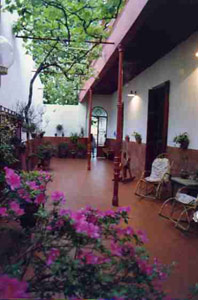
“I was born and raised in Buenos Aires, Argentina.  There, the summers were naturally hot and sweltering. While the temperatures did descend in winter months, it wasn’t so cold and the humid air still endured.  My family and I lived in a traditional, vernacular Buenos Aires home in the center of the city.  It dated from the 1800’s and was what we called a ‘Casa Chorizo.’   
 

Reflecting back on my childhood in that house, what I most remember is most always feeling comfortable within and the fresh fragrance of jasmine and azaleas in the luminous courtyard.  With cross-ventilation, the house stayed pleasantly fresh and cool, even though we didn't have air conditioning or ceiling fans.

Things changed when I moved into an apartment in a brand new building.  It was in a beautiful neighborhood of Buenos Aires with sweeping views across the metropolis.  However, this building did not offer the same refreshing experience that my childhood home did.  With the sun blasting into the large windows, the space became unbearable in the summer. I had to install blinds over the windows and an air conditioner which remained on 24 hours a day.  My beautiful view of the city was now shrouded in white fabric and I longed for the natural summer breezes.    

While this was an unpleasant experience, it helped me realize how much of an impact a building’s design can have on its inhabitants.  Now I understood more about my childhood home.  The thick walls produced an exceptional insulation.  The transom windows above the doors and windows pushed warm air across and out of the building.  The veranda provided a buffer from the high summer sun, but allowed the low winter sun to project light into the bedrooms, and grape vines growing above provided a handsome shading for the space below.    

An efficient design means responding to local climate and site conditions to maximize building users’ comfort and wind to provide household heating, cooling, ventilation and lighting, thereby reducing or removing the need for mechanical heating or cooling. Using passive design can reduce temperature fluctuations, improve indoor air quality and make a home drier and more enjoyable to live in.

This is why I passionately believe that architects should design buildings with comfort and resource-efficiency in mind.”